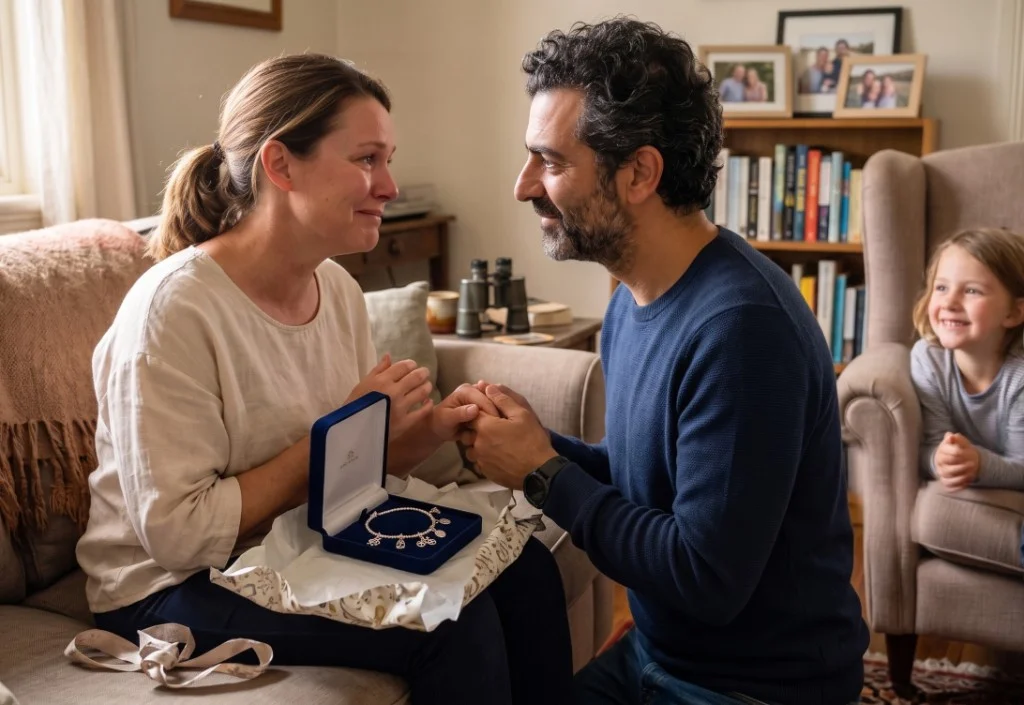
Because the best gift from a husband hits different. Here’s how to get it right.
The best Mother's Day gifts from a husband are specific to her, separate from what the kids give, and chosen with enough confidence that you hand it over feeling proud, not nervous. Experiences, upgraded everyday items, and anything tied to an interest she'd never splurge on herself consistently outperform generic options. Personal beats price tag.
Should Husbands Buy Their Wives a Mother's Day Gift?
Yes, and as a gesture that is clearly from you, separate from what the kids give. It does not need to be expensive; it needs to show you see her as your partner, not only as "Mum." A small, specific gift with a real note usually lands better than a big generic one.
She's probably the one who makes sure everyone else gets remembered. This is your chance to make sure she does too.
A picnic she didn't plan, a class in something she's been curious about, a morning exploring a new passion. Make it specific to her and it's sure to wow.
Swipe for ideas→
Upgrade her everyday
Need
What does she use every day that could feel 10% nicer?
Sharper snippers, a mug that actually keeps heat, slippers with real arch support. The upgrade she wouldn't buy for herself, because you noticed. Make it specific to how she actually lives and it's sure to wow.
Swipe for ideas→
Indulge her cravings
Feed
What does she crave but never carve out?
A single-origin tea collection, a botanical candle set, a pour-over ritual she didn't have to rush. Make it specific to her tastes and it's sure to wow.
Swipe for ideas→
What actually makes a great Mother's Day gift from a husband?
The best gifts are the ones you hand over feeling proud, not nervous.
That confidence comes from knowing the gift is specific: what she loves, what she would never splurge on for herself, and what she does every day that goes unnoticed.
What's the obsession she never stops talking about?
Birds, true crime, knitting, garden humor. Match the book or journal to the thing she already loves and it's sure to wow.
Swipe for ideas→
Spoil her senses
Want
What would she love but never buy herself?
A gold bee stud for the gardener, a botanical wall hanging for the nature lover, a custom portrait of the dog. Get it specific to her and it's sure to wow.
Swipe for ideas→
Make her laugh
Funny
What's the joke only you two would get?
Sarcastic plant markers, a true crime knitting pattern, gardening socks with absurd vegetable prints. Funny is easy. Funny and specific to her is a wow.
Swipe for ideas→
Wow her, fast
Last minute
What can you pull together by Sunday?
A class you can book tonight, slippers that ship tomorrow, a vineyard lunch this weekend. Last minute doesn't have to look last minute. Make it specific to her and it still lands as a wow.
Swipe for ideas→
Example Wishlist
What Nico saved for Kate
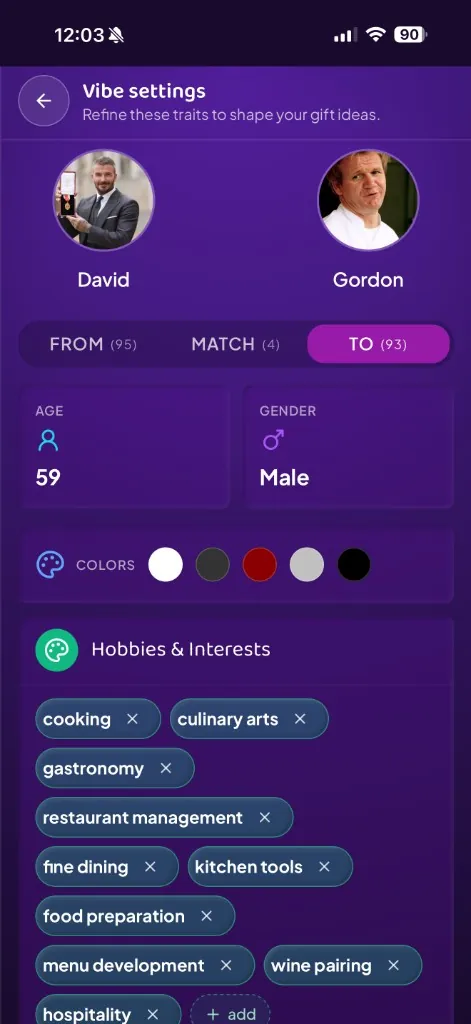
We made Nico and Kate up, but GiftyWow's recommendations are 100% real. From just two photos, one of Nico and one of Kate knitting on the veranda with her cup of tea and Ruby the dog beside her, we picked up on everything: the creative streak, the love of cozy rituals, all of it, and matched Mother's Day gifts that feel like they were chosen by someone who really knows her. Tap any tile to see why it made the cut.
cycling jerseypadded bib shortssports watchsalt-and-pepper hairathletic buildtechnical fabricsperformance weargroomed beardfunctional stylingactive aestheticnavy and white paletteaerodynamic fitoutdoor-readycasual groominghobby-specific attire
Environment & Home
red brick exteriorpaved patiotimber outdoor tablecharcoal kettle grillcorrugated metal fencevegetable gardenoutdoor seatingrecord player shelfvinyl collectionbackyard settingopen door to interiorsuburban landscape
Personality & Vibe
activetechnicalsocialdisciplineddetail-orientedenthusiasticrelaxed but focusedgear-head
hand-knittingvegetable gardeningbirdwatchingdog walkinglife with her golden retrieverreadingyogabotanyoutdoor relaxationsustainable livingcraftingnature observationtrue crime
Lifestyle & Spending
quality over quantityinvestment in toolswell-worn leatherartisanal ceramicsnatural materialssustainable choiceshobby-centric spendinglong-lasting goodsthoughtful dog gear and keepsakes
weatherboard exteriorcorrugated iron rooftimber deckingrattan armchairraised garden bedsnative Australian plantsjacaranda treeoutdoor verandawooden side tablerural-suburban settingnatural lightingproductive gardenbird-friendly environmentporch time with her dogpeaceful atmosphere
What is the best Mother's Day gift from a husband?
The best Mother's Day gift from a husband is the one that shows you've been paying attention to her specifically, not to a "gifts for wives" list. Research on gift giving consistently shows that a gift's emotional impact comes from three things: empathy, surprise, and sacrifice (Belk 1996), not the category it falls into. That means the question isn't "what's the best gift?" It's "what have I noticed about her this year that she doesn't know I've noticed?"
The "best gift" lists you'll find online are still organized around product categories: jewelry, spa vouchers, flowers, personalized mugs. Those can be useful starting points, but they can't do the final mile, which is matching a choice to a real observation about a real person. That's the job empathy, surprise, and sacrifice are doing below.
Empathy means the gift reflects something specific about her. Not "moms love candles," but "she's been reading about ceramics lately and would love a class with that potter she follows on Instagram." The closer the gift is to her actual life, the more it signals that you've been paying attention.
Surprise doesn't mean a shock. It means the gift reveals something she didn't expect you to notice. The best surprises feel inevitable in retrospect: "Of course that's perfect for me. How did he know?" Research by Belk and Coon (1993) found that small surprise gifts on no particular occasion are often more meaningful to recipients than larger gifts on expected occasions. On Mother's Day, you're working within an expected occasion, so the surprise has to come from the specificity of the gift itself, not the timing.
Sacrifice is the visible cost you bore, and it doesn't have to be financial. Time counts. Effort counts. A handwritten letter about specific moments you've watched her parent through this year carries more emotional weight than a $300 bracelet ordered in two clicks. Research consistently finds that recipients value perceived effort and genuine feeling over price (Ruth 1996; Zhang and Epley 2012). A gift that clearly cost you something, whether that's hours of thought, a drive across town, or the vulnerability of putting your feelings on paper, says more than one that cost you money alone.
Why "safe" gifts often aren't
Here's a finding that should change how you approach this: research by Givi and Galak (2017) found that givers tend to choose the "safe" option, a gift that reliably matches the recipient's known preferences, while recipients actually prefer the more emotionally ambitious option, the one tied to a shared memory, a deeper observation, or a creative risk.
Givers avoid the emotional gift because they're uncertain whether it will land. Recipients would rather have it, even with some risk of imperfection.
So the generic "best Mother's Day gift" lists aren't just unhelpful. They actively push you toward the wrong choice. They encourage safe, category-level thinking ("jewelry is always a hit") when the research says the better gift is the one that required you to know her specifically.
What actually makes a Mother's Day gift great from a husband
The best Mother's Day gift from a husband is the one that answers a single question: what have I noticed about her, this year, that she doesn't know I've noticed?
That could be:
The hobby she's quietly picked up since the kids started school
The restaurant she mentioned once, three months ago, that you remembered
The fact that she hasn't had a full day to herself since January
The book she keeps meaning to read but keeps putting aside for the kids' stuff
A photo from a moment this year that meant something to both of you, framed with a note about why
The common thread isn't the object. It's the observation. A great gift from a husband on Mother's Day proves that he sees her as a person, not just as a mother, and that he's been watching closely enough to know what would make her feel that.
Where GiftyWow fits
This is where we can help, especially if you know you should be more specific but you're stuck on where to start.
When you upload a photo of her into GiftyWow, we pull out over 100 details about who she is right now: her aesthetic, the brands she gravitates toward, her vibe (minimal or maximalist, curated or relaxed, classic or bold), the textures and materials she's drawn to, and the spending tier that fits her world. Then we do the same for you, because the gift has to feel right coming from you too.
From there, we generate ideas that sit in the overlap between what she'd love and what you'd be proud to give, scored against what actually makes a gift land. You swipe through them, and we learn what resonates. You can layer in your own personal context: the inside joke, the memory, the thing she said last Tuesday. We handle the deep profiling and the sourcing. You bring the one thing only you have: the relationship.
The result is a gift that looks like you spent weeks thinking about it, because the thinking that went into it is genuinely that deep. It just happened in seconds instead of hours.
That's not a shortcut. It's the difference between wanting to give a great gift and actually finding one.
What should I get my wife for Mother's Day if she has everything?
When a wife says she "has everything," it rarely means her life is out of things worth caring about. It usually means one of three things: her home already holds the objects she wants to own right now; she is gently telling you "please do not add clutter to my day"; or she is used to downplaying what she would enjoy because self-deprioritization is a habit, not a truth (Ruth 1996). In each case, the error is the same: shopping the "Mother's Day" aisle for a more expensive version of a generic object.
Research on gift-giving is consistent: what makes a gift feel meaningful is not the product category, but whether the gift shows empathy, surprise, and sacrifice (Belk 1996). For a mother who is materially comfortable, the sacrifice that reads as love is often time and attention you spent choosing—or time you return to her—more than a higher price point.
Shift lanes when the house is full
If the real constraint is saturation, the winning lanes are non-cluttering by design. Time and logistics are underrated: take the children for a full day, clear her calendar, handle meals and messages, and protect the boundary. For many mothers, a stretch of unclaimed hours is a gift that no wrapping paper can match because it directly reverses the chronic mental load of always being the default parent.
Experiences book fast and do not need permanent storage: dinner somewhere she has mentioned, a massage, a class she saved on social media, a night away, or a small ritual you do together. Experience gifts are not "lazy"; they are often more specific than objects because the gift is a date, a place, a seat, a promise you keep.
Consumables and upgrades still work when they are exquisitely specific: a tea she does not keep in the house, a beautiful everyday version of something she finishes, an ingredient she would not splurge on, or a premium replacement for a tool or textile she already uses weekly. The signal is: I notice what you use, and I want your daily life to feel better, not your closet fuller.
Letters, story objects, and the emotionally ambitious gift
Sometimes the right gift is a story object—a framed photo, a private joke made tangible, a small artifact tied to a trip or a year you both name out loud. And sometimes it is a letter that does what products cannot: it proves you were watching. Research on perceived effort and genuine feeling (Ruth 1996; Zhang and Epley 2012) consistently finds that effort reads as care even when the object is small.
Givers in high-stakes moments often default to a "safe" product pick because the emotional gift feels riskier. Recipients, however, frequently prefer the more emotionally ambitious option, even with imperfection (Givi and Galak 2017). A wife with "everything" is the scenario where the bold-but-specific gesture often outperforms another tasteful trinket.
The Wishless pattern—and what still "counts" as a gift
The practical move is to separate "I don't need anything" from "there is nothing worth giving." The first is often a Wishless pattern: she means it about clutter, and she will still feel whether you made room for her in your attention. The second is almost never true if you are specific enough. Shift lanes—time, experience, consumable luxury, a surgical upgrade, a memory, or logistics off her plate—and the gift stops competing with the open-tab wishlist in her head and starts competing on meaning instead.
It also helps to remember the household context many couples live in: one partner often carries a disproportionate share of gift-giving, calendar management, and household remembering across the year (McGrath 1995; Caplow 1982). Mother's Day is one of the few moments where a husband can reverse that flow with something that is clearly from him, not a family-wide token. A wife with "everything" can still be missing that asymmetry being acknowledged. You do not need a bigger object to address it. You need a choice that is unmistakably for her, tied to a fact about her that only you are likely to have noticed.
If you are stuck on what that specificity looks like in practice, GiftyWow is designed to get you from "she has everything" to a short list that is still about her, not a category. Upload a photo of her, and the app can surface a wide range of shoppable ideas scored against the kind of detail that is hard to fake—style, taste, and the life she is actually living right now, not a generic "gifts for mom" list.
What do you get your wife for Mother's Day when she's hard to buy for?
Start by figuring out why she's hard to buy for, because "hard to buy for" isn't one thing.
If she says "I don't need anything," she likely means it, but she'll still notice if you take her at her word and do nothing. Research on gift-giving calls this the Wishless pattern (Otnes et al. 1992), and it's one of the most common reasons husbands feel stuck on Mother's Day. The fix isn't to buy more stuff. It's to shift away from objects entirely and toward time, attention, and memory.
If the problem is that you and your wife have really different tastes, that's a different challenge altogether. Research calls this the Whole-Other problem, and it's why your instinct to buy something you'd like often backfires. The gift needs to land in her world, not yours.
Here's what the research says actually works for wives who seem impossible to shop for:
Experiences over things. A morning completely to herself. A lunch reservation somewhere she's mentioned wanting to try. A day trip she wouldn't plan for herself. These gifts say "I paid attention to what you actually want," which is the whole point.
Gifts that reference your shared history. A framed photo from a trip you both loved. A playlist of songs from a specific year. Research consistently shows that gifts tied to shared memory carry more emotional weight than almost any product (Schwaiger 2011).
Something she wouldn't buy herself. Not because it's expensive, but because she deprioritizes herself. A subscription to something she enjoys, a beautiful version of something she uses every day, or a genuinely luxurious consumable she'd normally skip.
The common mistake is defaulting to flowers and chocolates because they're "safe." They're safe in the sense that they won't offend, but they also won't land. A Mother's Day gift from a husband should signal "I see you, specifically," not "I remembered the date."
This is exactly the kind of situation we built GiftyWow to handle. Upload a photo of each of you, and we'll pull out over 100 details about her style, her vibe, the brands she gravitates toward, and even the textures and colors she's drawn to. Then we map where your tastes align and where they diverge, and find gifts in the sweet spot: something she'll love that you'll also feel proud handing over.
Even for the wife who says she doesn't need anything, the photo tells us more than she'll ever say out loud.
Is it normal for husbands to celebrate Mother's Day with their wives?
Yes, and the research backs up why. In most families, Mother's Day has evolved well beyond celebrating your own mother. It's now one of the primary occasions where husbands recognize their wives' role as mothers, and it carries real emotional weight.
Here's why it matters more than you might think: decades of consumer behavior research confirm that in the majority of households, one person carries a disproportionate share of the gift-giving labor across the entire year, including Christmas, birthdays, family events, and school occasions (McGrath 1995; Caplow 1982). That person handles the planning, shopping, wrapping, and remembering. Mother's Day is one of the few moments where the flow reverses and that effort gets acknowledged.
So when a husband celebrates Mother's Day with his wife, he's not just honoring her parenting. He's recognizing the broader caregiving and relationship work she does for the family, much of which goes unnoticed the rest of the year.
If you're unsure what to do, the bar isn't high and the gesture doesn't need to be extravagant. A card with something specific you've noticed her do as a mum. Breakfast she didn't have to organize. A few hours where she's genuinely off duty. The emotional value of a gift comes from empathy and visible effort (Belk 1976), not price.
If you want to go further, GiftyWow can help you find something that actually reflects who she is. Upload her photo, and in seconds you'll have gift ideas matched to her personality, her style, and the life stage she's in right now. Not a generic "gifts for mom" list. Because the whole point of this day is making her feel seen, and that starts with noticing the details.
What are good last-minute Mother's Day gift ideas for a wife?
Running out of time doesn't mean you have to settle for a generic gift. But it does mean you need to be honest about what happens when you're short on time: you default to whatever's fast and available, and the gift ends up looking exactly as last-minute as it was. The research calls this Acknowledger behavior (Otnes et al. 1993), where the gift says "I met the obligation" instead of "I thought about you."
The good news is that the difference between a generic gift and a personal one isn't time. It's specificity. A gift that reflects something real about her, her taste, her current obsession, the thing she mentioned wanting last month, looks thoughtful regardless of when you bought it.
Here are last-minute options that still carry real emotional weight:
Write her a letter. Not a card with a pre-printed message. An actual handwritten note about what she does as a mum that you notice and value. Research on gift-giving shows that perceived effort and genuine feeling matter more than the object itself (Ruth 1996). A letter is pure signal.
Book something she'd love. A restaurant reservation, a massage, a class she's mentioned. Experience gifts rate as high as or higher than physical gifts across most research, and they take minutes to arrange.
Give her time. Take the kids for the full day. Handle every meal, every mess, every decision. For many mothers, the most valuable gift is a stretch of time where no one needs anything from them.
If you want an actual product she'll love and you're starting with zero ideas at 9pm the night before, that's exactly when GiftyWow earns its keep. Upload a photo of her, and in seconds you'll have a shortlist of gift ideas matched to her style, her vibe, and her spending tier, with links to buy them right now.
What would normally take hours of scrolling, second-guessing, and settling happens in the time it takes to swipe through a few cards. Your gift will look like you've been planning it for weeks, because the depth of thinking behind it is real. It just happened fast.
How much should a husband spend on a Mother's Day gift?
There isn't a magic number, and research suggests the question itself might be leading you in the wrong direction.
Multiple studies on gift-giving have found the same pattern: givers believe that spending more will make the recipient appreciate the gift more, but recipients don't actually rate expensive gifts higher than less expensive ones when other factors are equal (Flynn and Adams 2009). The giver assumes price signals love. The recipient reads the gift for something else entirely: empathy, effort, and whether it feels personally chosen.
That said, the gift shouldn't feel careless relative to your household's means. A gift that's obviously cheap from someone who could comfortably afford more reads as low regard, not frugality. Conversely, overspending beyond what feels natural for your family can create an awkward sense of pressure rather than delight. The research on reciprocity is clear on this: the most comfortable gifts land in a range that feels proportionate to the relationship and the household context (Caplow 1984).
So instead of asking "how much should I spend," try asking "what would show her I actually thought about this?" A $20 gift that reflects something specific about her life as a mum will almost always outperform a $200 gift grabbed from a "top gifts for her" list.
This is one of the things GiftyWow handles quietly in the background. When you upload a photo, we pick up on spending-level signals: the brands she wears, the quality of the things around her, whether her style leans toward curated luxury or relaxed everyday basics. Our recommendations calibrate to her world automatically, so the gifts we suggest sit at the right level without you having to guess.
You don't need to set a budget. We read the cues and match to them, which takes one of the most anxiety-inducing parts of gift shopping completely off your plate.
A useful rule of thumb if you're shopping on your own: spend what you'd spend on a thoughtful birthday gift for her, adjusted for what your family budget looks like right now. Mother's Day sits roughly at birthday-level significance for most couples. If you're in a tight season financially, lean toward time and effort instead of dollars. That's not a consolation prize. It's often the better gift.
Ready to find the perfect gift?
Snap a photo. Let me read their vibe. You get a curated gift edit in under two minutes.