GiftyWow (opens in a new tab)
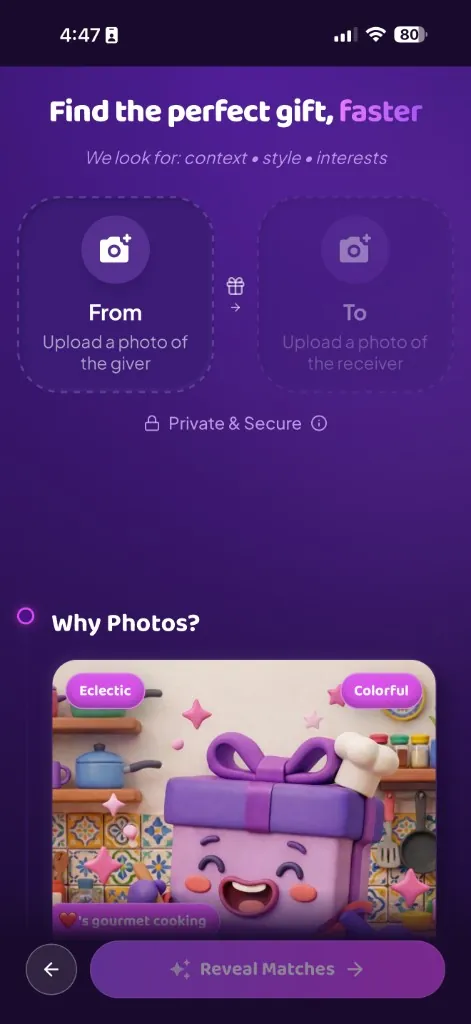
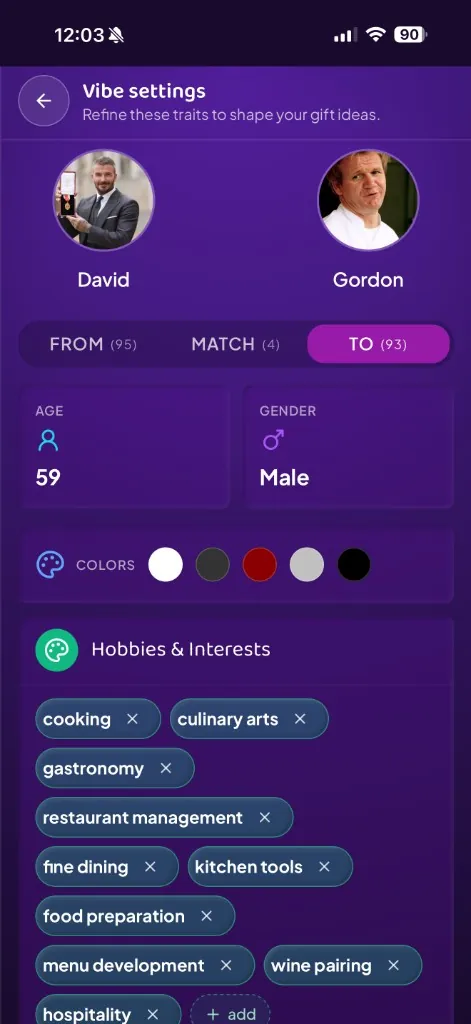
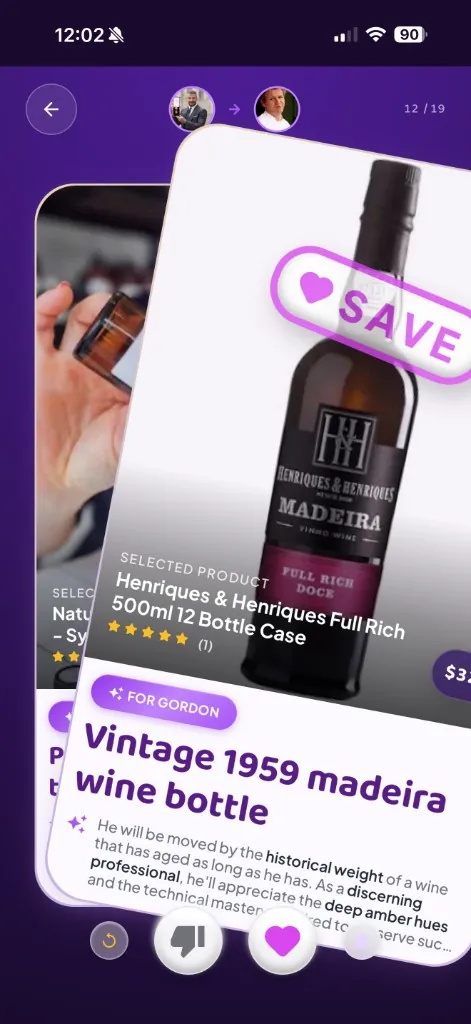
Photo matchUpload photos of the giver and receiver, get gift ideas matched to both people. Swipe to browse, compare product options, see what others liked.
June 2026 · 7 tools · 3 scenarios
Seven tools, three test scenarios, every recommendation scored the same way. Not feature checklists. Actual gifts.
Tested June 2026 · Updated June 23, 2026
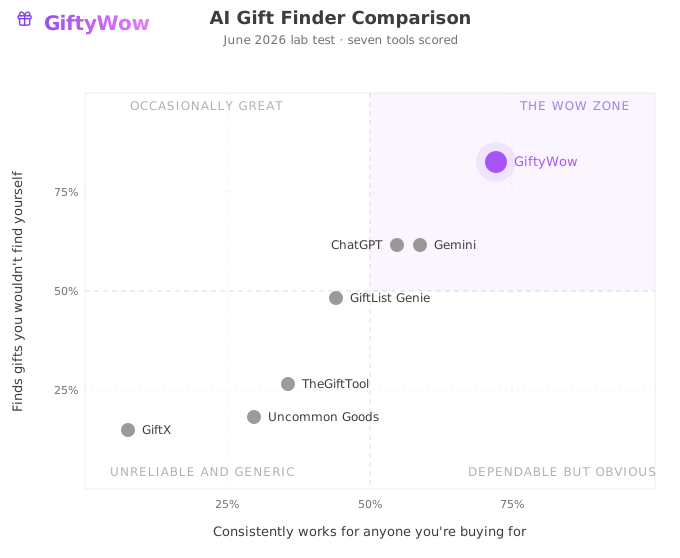
Which AI gift finder is best after testing? GiftyWow delivered the strongest and least generic recommendations across three real test scenarios. ChatGPT and Gemini are competitive free alternatives for common recipients. GiftList Genie peaked on standard hobbyists but dropped on harder cases. Quiz tools and curated retailers underperformed. This page is an AI gift finder comparison with published overall scores and generic rates from June 2026 testing.
GiftyWow delivered the most consistently strong and least generic recommendations across three very different gift scenarios. It was the only tool that stayed in the top two in every test, and the only one where fewer than 12% of passing recommendations were things you could have found through a Google search.
ChatGPT and Gemini are competitive free alternatives, especially for common recipient types. Gemini actually edged GiftyWow's overall score on the anniversary scenario, though several of its recommendations couldn't be verified as purchasable products. The dedicated quiz tools and curated retailers underperformed across the board.
Read on for the full results, with actual gift examples from every tool.
You could walk into a store and scan thousands of products in person. You could browse Amazon for an hour. You could ask your friends. All of those methods are faster and more familiar than typing a brief into a chatbot.
The only reason to use an AI gift finder is if it finds the gift you can't find through normal browsing. The one that makes them say, "How did you know?"
If the tool just returns the same things you'd get from page one of a Google search, it's failed at the one job that justifies its existence. It's slower than Google, less efficient than Amazon, and more effort than asking a friend. The whole value is in the discovery: the unexpected find that's still exactly right.
That's what we tested. Not features. Not quiz formats. Not wishlist integrations. We tested whether these tools actually find gifts worth giving, and specifically whether they find gifts you couldn't find yourself.
For how GiftyWow compares to the other ways you normally find gifts (not just AI tools), see our full comparison .
We selected seven tools that cover the main approaches people use to find gifts with AI: photo-based matching, general-purpose chatbots, quiz-based finders, chat-based recommendation, and curated retail catalogs.
These seven represent the categories a real searcher would encounter. We excluded tools that were no longer operational, had no functional web presence, or produced results too poor to evaluate meaningfully. There are dozens of AI gift finders listed across comparison articles online. Many no longer work.
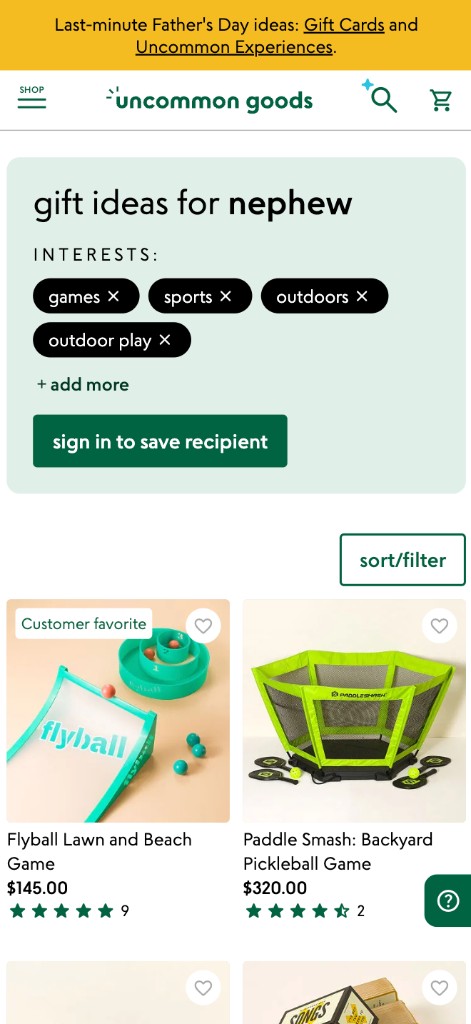
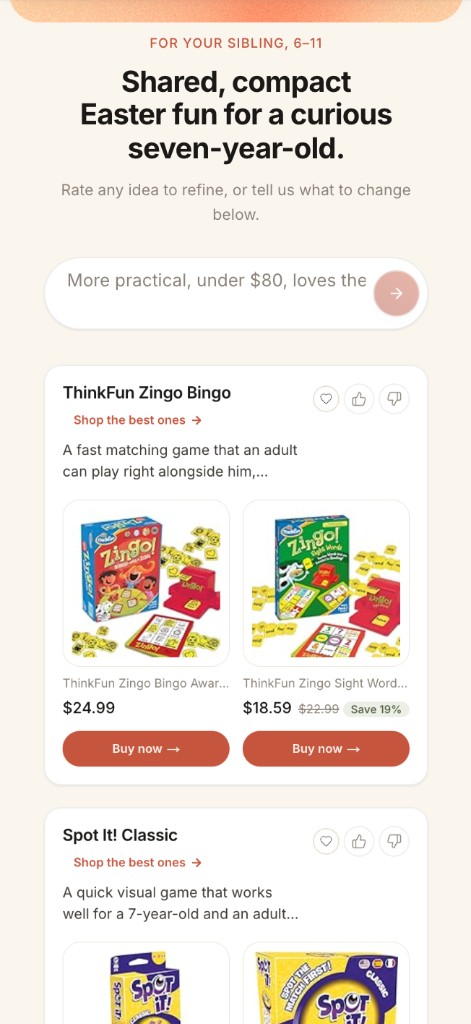
Swipe or scroll the row to see each tool's interface screenshot.
So we kept it more realistic: we gave ChatGPT a photo for one scenario too, to see if it made a difference (it did, but not enough to change the outcome).
We gave every tool the same written brief for each scenario and asked for 20 gift ideas. Then we scored every recommendation against a structured evaluation framework designed specifically for gift giving.
Gift recommendations aren't like most AI tasks, where there's one right answer. A birthday gift for a 47-year-old who fishes, homebrews, smokes meat, and cycles has millions of possible good answers. Our framework evaluates each recommendation on whether you'd actually want to give it: Is it the right age? Within budget? Does it match their interests at a specific enough level? Would they already own it? Does it avoid the occasion landmines? And critically: is it something you could have found yourself, or is it a genuine discovery?
To learn more about how we built an evaluation framework for a product with millions of possible good answers, read about our approach to AI evals .
An important note about fairness: For GiftyWow, we only scored the AI-generated recommendations, not the initial picks served from our pool of over 10,000 gift ideas that real users have already liked. This means the results reflect GiftyWow's matching engine alone, not the full product experience. GiftyWow also received photos of both people (because that's how the product works), while the other tools received only the written brief. So we kept it more realistic: we gave ChatGPT a photo for one scenario too, to see if it made a difference (it did, but not enough to change the outcome).
Before looking at recommendation quality, here's what each tool actually does. These are product features, not evaluation scores.
| Feature | GiftyWow | ChatGPT | Gemini | GiftList Genie | GiftX | Uncommon Goods | TheGiftTool |
|---|---|---|---|---|---|---|---|
| Input method | Photos of both people | Text prompt (optional photo) | Text prompt | Text chat | Quiz | Filters | Quiz |
| Matches to giver (not just recipient) | |||||||
| Purchase links | Pro only | ||||||
| Multiple product options per idea | |||||||
| Recommends experiences | If prompted | If prompted | |||||
| Swiping / browse experience | |||||||
| Social proof (what others liked) | |||||||
| Explains why each gift fits | If asked | If asked | |||||
| Wishlist / occasion tracking | |||||||
| Remembers previous recommendations | Within session | Within session | |||||
| Free tier | 3 matches/day | Yes | Yes | Yes | Yes | N/A (retail store) | Yes |
| Retailer coverage | Multi-retailer | N/A (no links) | Google Shopping (Pro) | Amazon | Amazon-heavy | Own catalog only | Amazon-heavy |
We chose three scenarios that cover three of the most common gift-finding situations: buying for a parent or friend with hobbies, buying for a kid in the family, and buying for a partner.


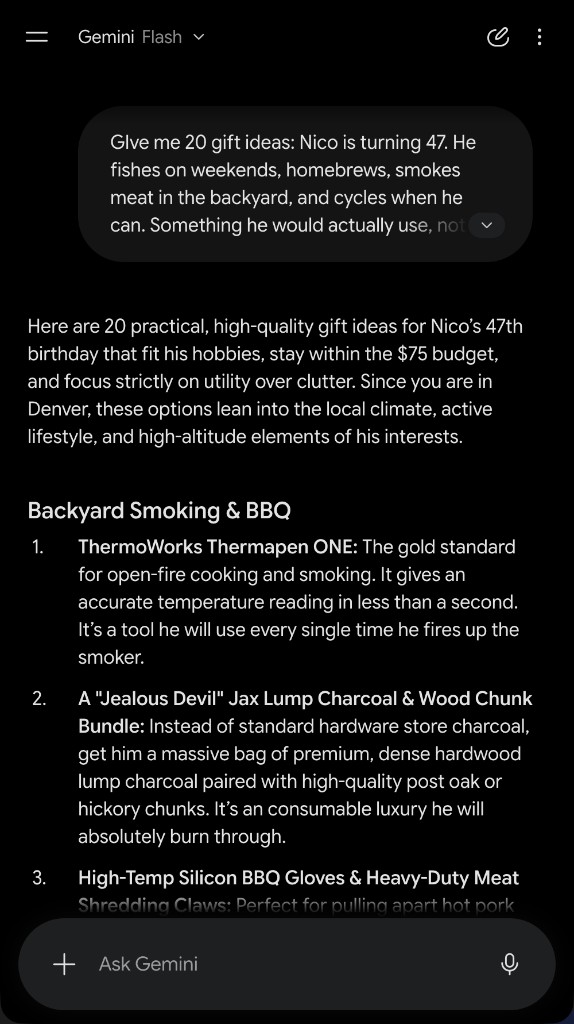
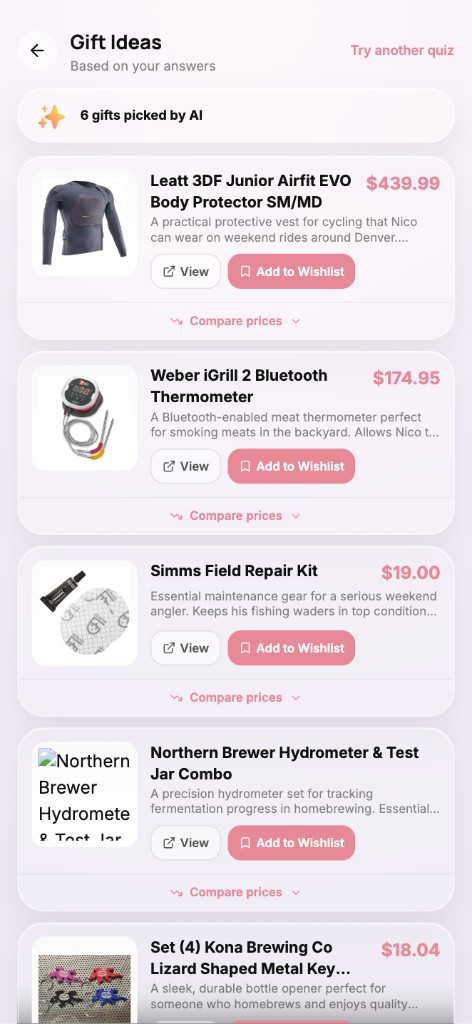
Nico is turning 47. He fishes on weekends, homebrews, smokes meat in the backyard, and cycles when he can. Something he would actually use, not clutter. He already owns the basics for everything.
GiftyWow reads both portraits before matching. These signals come from the eval photo-match run — not typed into the brief other tools received.
Husband — close relationship
Receiver: Nico · 48 signals
Traits
Materials
Avoid
Environment
Giver: Kate · 52 signals
Traits
Materials
Avoid
Environment


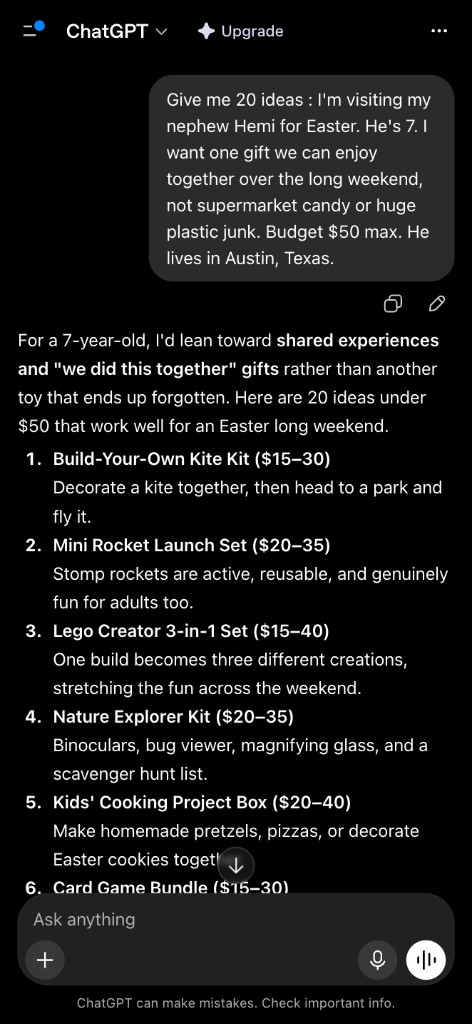
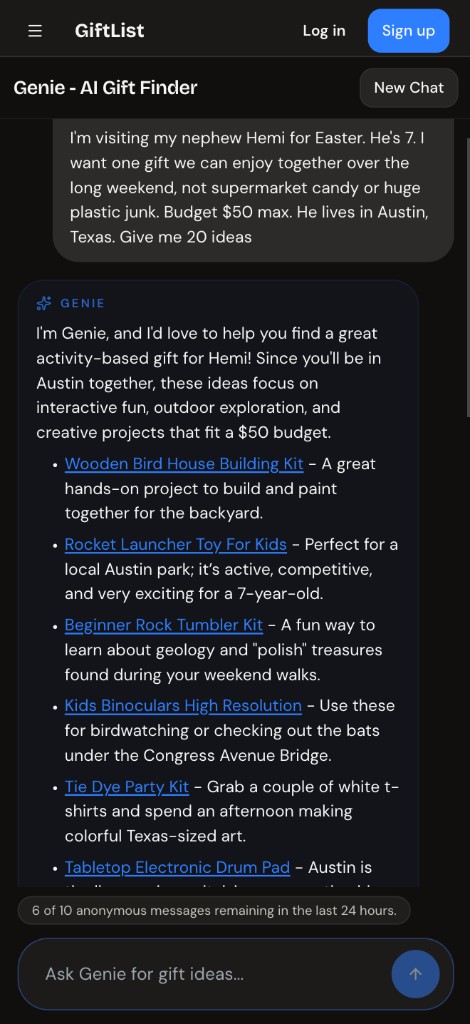
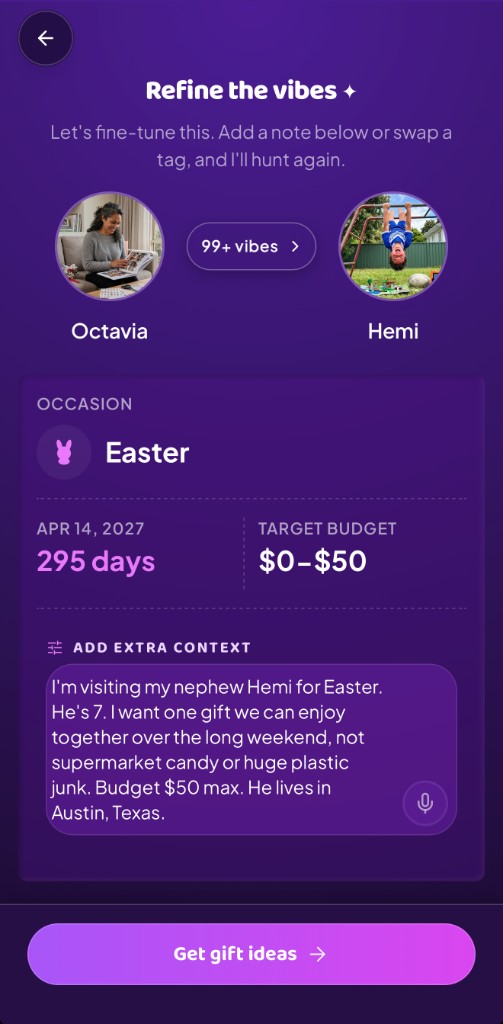
I'm visiting my nephew Hemi for Easter. He's 7. I want one gift we can enjoy together over the long weekend, not supermarket candy or huge plastic junk.
GiftyWow reads both portraits before matching. These signals come from the eval photo-match run — not typed into the brief other tools received.
Aunt — strong tie, visiting for the holiday
Receiver: Hemi · 38 signals
Traits
Materials
Avoid
Environment
Giver: Mia · 44 signals
Traits
Materials
Avoid
Environment


He's got eclectic taste and is very into design. Loves a rooftop bar. Already has everything. Something he'd never find himself.
GiftyWow reads both portraits before matching. These signals come from the eval photo-match run — not typed into the brief other tools received.
Husband — strong tie, 15th anniversary
Receiver: Simon · 46 signals
Traits
Materials
Avoid
Environment
Giver: Olivia · 42 signals
Traits
Materials
Avoid
Environment
| Scenario | Overall score | Usable | Wrong | Generic rate |
|---|---|---|---|---|
| Nico's birthday | 73.6% | 17/18 | 0 | 6% |
| Hemi's Easter | 72.1% | 17/20 | 2 | 12% |
| Anniversary | 73.0% | 18/18 | 0 | 6% |
GiftyWow was the only tool that stayed in the top two across all three scenarios, with a score range of just 1.5 points (72.1 to 73.6%). That kind of consistency didn't appear anywhere else in the test.
The standout quality was discovery depth. Across all three scenarios, between 88% and 94% of GiftyWow's passing recommendations were things you wouldn't find through an obvious Google search. Two gifts in particular showed what photo-based dual-person matching can do that other approaches can't. For Nico, a hickory wood fly fishing box connected his smoking-wood aesthetic with his fishing hobby, a cross-interest match no other tool found. For Hemi, a sunprint cyanotype kit connected the giver's photography interest with the nephew's love of outdoor play, a gift that works because of who's giving it, not just who's receiving it.
The weaknesses were minor. Two recommendations in the Hemi scenario were wrong for the context, and a handful of picks across scenarios were solid but not surprising. The overall sets were rated exceptional in two scenarios and strong in the third.
For GiftyWow, these results reflect only the AI-generated recommendations. The full product experience starts with picks from a pool of over 10,000 gifts that real users have already liked, then layers in the AI-matched ideas. We excluded the pool to test the matching engine alone. To learn more about how GiftyWow works, read about us here.
| Scenario | Overall score | Usable | Wrong | Generic rate |
|---|---|---|---|---|
| Nico's birthday | 52.5–54.7% | 10–15/20 | 0 | 33–64% |
| Hemi's Easter | 56.0% | 12/20 | 2 | 33% |
| Anniversary | 71.7% | 19/20 | 0 | 16% |
ChatGPT performed best on the anniversary scenario (71.7% overall score, within 2 points of GiftyWow) and weakest on the hobbyist scenario (52.5–54.7% depending on whether it received a photo). The 19-point swing between its strongest and weakest scenario is worth noting: ChatGPT is excellent when the gift category maps well to its training data, but less reliable for multi-hobby recipients where specificity matters.
We tested ChatGPT with and without a photo for the Nico scenario. The photo helped: pass rate jumped from 50% to 75%. But even with the photo, ChatGPT produced zero surprising finds. Every recommendation was something you'd see on page one of a Google search for "gifts for a guy who fishes and homebrews." The generic rate tells the story: between 16% and 64% of ChatGPT's passing recommendations were things you could have found yourself, compared to GiftyWow's 6–12%.
ChatGPT's strongest quality is thoughtful reasoning. It explains why each gift fits, and many of its recommendations feel considered even when they're not surprising. Its weakest quality is discovery. If you already know roughly what you want and need help refining the idea, ChatGPT is a solid free tool. If you're hoping to be surprised, look elsewhere.
| Scenario | Overall score | Usable | Wrong | Generic rate |
|---|---|---|---|---|
| Nico's birthday | 58.8% (Flash) | 16/20 | 0 | 8% |
| Hemi's Easter | 59.5% | 14/20 | 0 | 14% |
| Anniversary | 74.6% (Flash) | 18/20 | 0 | 22% |
Gemini produced the highest single-scenario overall score in the entire test: 74.6% on the anniversary, edging GiftyWow by 1.6 points. It also achieved zero wrong suggestions in two of three scenarios, which no other tool managed.
The important caveat: several of Gemini's anniversary recommendations couldn't be verified as purchasable products. The overall score doesn't currently penalize hallucinated recommendations (products that sound real but don't exist or can't be found at the stated price). If hallucination verification were part of the scoring, Gemini's anniversary result would likely drop. This is a known limitation of the current evaluation framework, and one we plan to address (see "What's missing" below).
Gemini's performance also varied significantly depending on which model version we used. For the Nico scenario, the Flash model scored 58.8% while the Pro model scored just 32.2%. If you use Gemini for gift ideas, the model matters.
There's also a practical trade-off between Gemini's models: Flash produced stronger recommendations but doesn't include product links, while Pro includes Google Shopping links but scored nearly half as well (32.2% vs 58.8% on the Nico scenario). Using Gemini for gift finding means choosing between better ideas or easier purchasing.
The generic rate ranged from 8% to 22%, sitting between GiftyWow's consistently low 6–12% and ChatGPT's higher 16–64%. Gemini finds more non-obvious gifts than ChatGPT but fewer than GiftyWow, with the added risk that some of those "non-obvious" finds may not be real products.
| Scenario | Overall score | Usable | Wrong | Generic rate |
|---|---|---|---|---|
| Nico's birthday | 58.4% | 12/20 | 0 | 33% |
| Hemi's Easter | 43.9% | 11/20 | 1 | 27% |
| Anniversary | 55.4% | 12/20 | 0 | 8% |
GiftList Genie tells the most interesting consistency story in the test. For the standard hobbyist scenario (Nico), it performed well: 58.4% overall score, zero wrong suggestions, and practical picks across all four hobbies. But the score dropped 15 points for the Hemi scenario (43.9%), where the unusual relationship dynamic (aunt and 7-year-old nephew at Easter) sat outside the tool's sweet spot.
The weakness is depth. A third of GiftList Genie's passing recommendations for Nico were generic (things like a portable bike floor pump or a digital meat thermometer that a 47-year-old hobbyist almost certainly owns already). The anniversary result was stronger on generic rate (only 8%) but weaker on overall score.
GiftList Genie doubles as a wishlist platform, though GiftyWow also captures wishlists, tracks occasions over time, remembers what's already been recommended so you're not starting fresh each time, and lets you flag gifts as bought to keep a running memory of what you've given. If you're buying for an adult with clearly defined hobbies, GiftList Genie is a reasonable option. For more complex gift-finding situations (kids, unusual occasions, recipients who "already have everything"), the results suggest looking elsewhere.
| Scenario | Overall score | Usable | Wrong | Generic rate |
|---|---|---|---|---|
| Nico's birthday | 37.9% | 13/20 | 2 | 38% |
| Hemi's Easter | 39.4% | 14/20 | 3 (gate fail) | 36% |
| Anniversary | 7.6% | 0/20 | 0 (gate fail) | No passes |
GiftX's quiz format produced the most dramatic failure in the entire test. For the anniversary scenario ("eclectic taste, into design, already has everything, something he'd never find himself"), GiftX scored 7.6% overall with zero passing recommendations out of 20. Not a single suggestion was worth considering.
The Nico and Hemi scenarios were marginally better but still weak. The Hemi results included a $120 Magna-Tiles set on a $50 budget, the kind of basic constraint violation that erodes trust. The generic rate across passing scenarios sat at 36–38%, meaning more than a third of the adequate recommendations were things you'd find through obvious searches anyway.
The core problem is structural. A quiz captures age, interests, and budget, but it can't capture the subtler signals that determine whether a gift feels "right." When the recipient doesn't fit neatly into standard hobby categories (a design-oriented person with eclectic taste, for example), the quiz has no way to adapt. The 32-point swing between GiftX's strongest and weakest scenarios (39.4% to 7.6%) illustrates this limitation.
| Scenario | Overall score | Usable | Wrong | Generic rate |
|---|---|---|---|---|
| Nico's birthday | 30.3% | 5/20 | 1 | 0% |
| Hemi's Easter | 29.6% | 7/20 | 8 (gate fail) | 0% |
| Anniversary | 35.8% | 5/20 | 5 (gate fail) | 60% |
Uncommon Goods is a curated retail store, not an AI gift finder in the traditional sense. We included it for two reasons: it appears in many "best AI gift finder" articles that searchers encounter, and it's a genuinely interesting test case. Uncommon Goods sells products specifically designed to be surprising, distinctive, and delightful. If any retail catalog should score well on discovery, it's this one. The results show that even a catalog full of distinctive products can fail when the matching is poor.
The core limitation is inventory: Uncommon Goods can only recommend products it sells, which constrains matching to a relatively narrow range. For the Hemi scenario, this meant 8 out of 20 recommendations were flat-out wrong for a 7-year-old, the harshest single result across any tool in any scenario. The catalog skews toward adults, and the recommendation filter couldn't compensate.
When the catalog happens to match the recipient, the individual products can be interesting (the 0% generic rate for Nico and Hemi reflects genuinely distinctive artisan goods). But low generic rate means nothing when most of the recommendations miss on basic fit.
| Scenario | Overall score | Usable | Wrong | Generic rate |
|---|---|---|---|---|
| Nico's birthday | 35.6% | 5/20 | 0 | 60% |
| Hemi's Easter | 39.5% | 9/20 | 5 (gate fail) | 22% |
| Anniversary | 43.6% | 7/20 | 0 | 0% |
TheGiftTool was the most consistently mediocre performer. No catastrophic failures like GiftX's anniversary result, but no strong showings either. Overall scores ranged from 35.6% to 43.6% across the three scenarios, never approaching the competitive tier.
The Nico scenario exposed the generic problem sharply: 60% of passing recommendations were things you'd find on a basic Google search. Five suggestions in the Hemi scenario were wrong for a 7-year-old, including items from entirely wrong age categories.
The quiz format is quick (a few questions, instant results), but the speed comes at the cost of depth. Without richer input about the recipient, the tool defaults to category-level matches rather than genuinely personalized recommendations.
One scenario can be a fluke. Three scenarios covering different ages, relationships, and occasions reveal which tools genuinely match gifts to people and which ones got lucky once.
| Tool | Nico | Hemi | Anniversary | Range |
|---|---|---|---|---|
| GiftyWow | 73.6% | 72.1% | 73.0% | 1.5 pts |
| Gemini | 58.8% | 59.5% | 74.6%* | 15.8 pts |
| ChatGPT | 52.5–54.7% | 56.0% | 71.7% | 19.2 pts |
| GiftList Genie | 58.4% | 43.9% | 55.4% | 14.5 pts |
| GiftX | 37.9% | 39.4% | 7.6% | 31.8 pts |
| Uncommon Goods | 30.3% | 29.6% | 35.8% | 6.2 pts |
| TheGiftTool | 35.6% | 39.5% | 43.6% | 8.0 pts |
*Gemini's anniversary overall score includes recommendations that couldn't be verified as purchasable.
GiftyWow's overall score swings just 1.5 points across three completely different scenarios. Every other competitive tool swings at least 15 points. Gemini's 74.6% anniversary score is impressive, but its 58.8% Nico score shows the floor is substantially lower. ChatGPT swings 19 points. GiftX swings 32 points, from passable to non-functional.
The generic rate reinforces the pattern. Across all three tests, 88–94% of GiftyWow's passing recommendations were genuinely non-obvious finds. For ChatGPT, that number ranged from 36% to 84%. For Gemini, 78% to 92%. When the overall scores are close, the generic rate separates tools that find gifts you couldn't find yourself from tools that dress up a Google search as a recommendation.
Three things set GiftyWow's results apart.
We built this comparison to be as fair and transparent as we could. It's also a work in progress. Here's what the current evaluation doesn't yet cover, and what we're doing about it.
The current framework scores recommendations on quality, relevance, and fit. It doesn't yet verify whether every recommended product actually exists and can be purchased at the stated price. This matters most for the general-purpose chatbots: both ChatGPT and Gemini occasionally recommend products that sound plausible but can't be found on any retailer. In the anniversary scenario, several of Gemini's top-scoring recommendations fell into this category. We're adding purchasability verification to the next version of the rubric. For GiftyWow, this isn't a factor: every recommendation links to a verified product at a confirmed price.
Three scenarios is a start. We've mapped out more than 500 gift-giving contexts covering different recipient types, occasions, relationships, budgets, and constraints. We're working through them systematically, and we'll update this page as more results come in. The goal is to cover the full range of situations a real gift-giver encounters, not just the easy ones.
As noted above, we only scored GiftyWow's AI-generated recommendations for this comparison. The full product experience starts with picks from a pool of over 10,000 gifts that real users have already liked, then layers in the matched ideas. A future evaluation will test the complete experience.
Our current evaluation uses Gemini as the scoring judge. This raises a legitimate question: does Gemini score its own outputs more favorably than it scores competitors? Self-preference bias is a known issue in LLM-based evaluation, and we've observed patterns that suggest it may be a factor here. We're planning a cross-model evaluation test, running the same rubric through multiple judge models (including Claude, GPT-4, and others) to check whether scores stay consistent regardless of which model does the scoring. If they don't, we'll adjust the methodology and publish the results.
GiftyWow is a specialist focused entirely on gift finding. Every evaluation teaches us something, and we feed those learnings back into the matching engine. The scores on this page reflect a snapshot. The product is evolving continuously, and we apply our evaluation framework to every iteration to make sure the direction is up and to the right. These results will be updated as the product and the rubric continue to develop.
Based on our testing of seven tools across three real scenarios, GiftyWow delivered the strongest and most consistent results. It was the only tool that scored in the top two in every test, and between 88% and 94% of its passing recommendations were things you wouldn't find through a Google search. ChatGPT and Gemini are competitive free alternatives for straightforward recipients but swing more across different scenario types. For the full breakdown, see the tool-by-tool results above.
It depends on the tool. Our testing showed that most AI gift finders return recommendations you could find through a Google search yourself, which makes them slower than browsing, not faster. The value only kicks in when the tool finds something you wouldn't have found on your own, and only a few tools in our test did that consistently.
Most are. ChatGPT, Gemini, GiftList Genie, GiftX, and TheGiftTool all offer free access. GiftyWow has a free tier with 3 matches per day, plus a Plus plan at $9.99/month for 150 matches with no daily cap.
They can, but quality varies dramatically. In our Easter scenario for a 7-year-old, one tool had 40% of its recommendations fail on basic age-appropriateness. Quiz tools in particular struggled with the unusual relationship dynamic (aunt buying for a nephew during a visit). If you're buying for a child, check the tool's output carefully before committing.
ChatGPT is a solid brainstorming tool for gift ideas, though in our testing it didn't provide working purchase links. The main differences: dedicated gift finders use structured input (photos, quizzes) to capture details you wouldn't think to include in a prompt. GiftyWow specifically reads both the giver and receiver to find the overlap between them. ChatGPT's quality depends on how detailed your prompt is, and our testing showed its generic rate (the percentage of passing recommendations you could have found through Google) ranged from 16% to 64%, compared to GiftyWow's 6–12%.
A gift quiz runs your answers through a decision tree to match pre-selected categories. A gift finder uses more flexible matching. In our testing, quiz tools (GiftX, TheGiftTool) produced adequate individual gifts for standard recipients but collapsed for unusual scenarios. GiftX scored 0% on the anniversary scenario (zero passing recommendations out of 20), revealing a structural limitation of the quiz format for recipients who don't fit neat categories.
This varies widely. Most tools perform reasonably well for standard recipients (adult with clear hobbies) but struggle with unusual relationship dynamics, non-standard occasions, or complex constraints. GiftyWow was the only tool that maintained strong results across all three scenarios, including the harder ones (buying for a 7-year-old nephew at Easter, finding something a design-lover who "already has everything" would never find himself).
The overall score combines four equally weighted factors: how well each recommendation scored against our quality rubric (is it the right age, budget, occasion, and specificity level?), the pass rate (what percentage of recommendations were worth giving?), the surprise and delight rate (did the tool find non-obvious gifts?), and set quality (does the shortlist as a whole give you enough variety and range to actually find a gift?). Each factor counts for 25% of the score. A tool with high pass rate but low surprise scores lower than a tool with slightly fewer passing gifts but more genuine discoveries.
GiftList Genie is a decent tool for recipients who fit standard hobby categories, and it includes wishlist functionality. In our testing, it scored 58.4% for the standard hobbyist but dropped to 43.9% for the more unusual Easter scenario. GiftyWow scored 72–74% in all three and also offers wishlists, occasion tracking, and a memory of what you've already given. The biggest structural difference is input: GiftList Genie uses a text chat, GiftyWow reads photos of both people to find the overlap.
GiftX uses a quiz format. In our testing, it produced weak results across the board and scored 7.6% overall on the anniversary scenario, with zero passing recommendations. GiftyWow outperformed GiftX on every metric in every scenario, with a minimum score of 72.1% versus GiftX's maximum of 39.4%.
How GiftyWow compares
Google and listicles, gift quizzes, Amazon finders, asking friends, and chatbots vs photo-led matching.
Standard AI Evals Assume One Right Answer
LLM-as-a-judge for personalised gifting: why one-expert benchmarks fail, and how we built in-product labs, a proprietary rubric, and scalable evals with no single correct answer.
About GiftyWow
How photo-led matching works — upload, review your read, swipe ideas that fit.
Upload a photo of you and a photo of them. Your first match is free, and it takes about sixty seconds.
Start Matching